Every so often, ideas pop into my head that expand the world of ⚡Thorunn⚡, and Fathoms is one of those. I quite enjoyed writing this piece, since the style is not one I typically, use, but ⚡Thorunn⚡ really demanded that each POV I wrote in was shaped by the headspace of the characters, so this one is rather spare although carefully evocative.
The header art that is embedded within the PDF file below is highly metaphorical, and I invite readers to draw their own conclusions about its meaning when paired with the writing that follows.
I do caution you to read this piece after finishing the novel if you’d like to stay spoiler-free.
I’m thrilled to announce that the exclusive behind-the-scenes vlog for the making of the official ⚡THORUNN⚡ audible audiobook is now streaming exclusively on youtube!
From the first exciting moments as I began embarking on this brand new endeavour, to pushing through unexpected and debilitating pain, this vlog documents the highs and lows of recording, editing, and producing the dynamic and engaging 13-hour long audiobook companion.
Be sure to drop any questions you have about the process in the comments, and don’t forget to download the audible app so that you can listen to ⚡THORUNN⚡ wherever you find yourself.
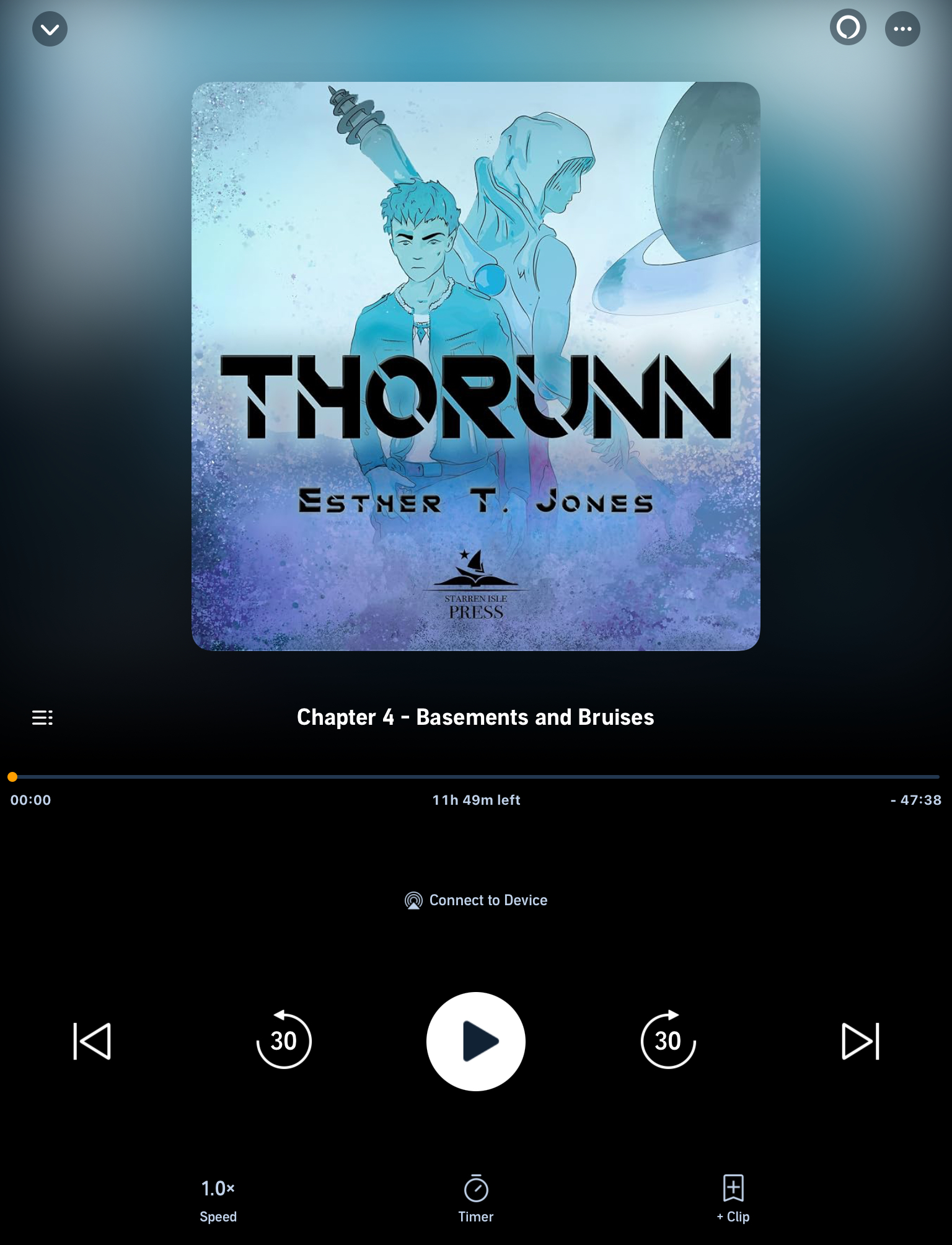
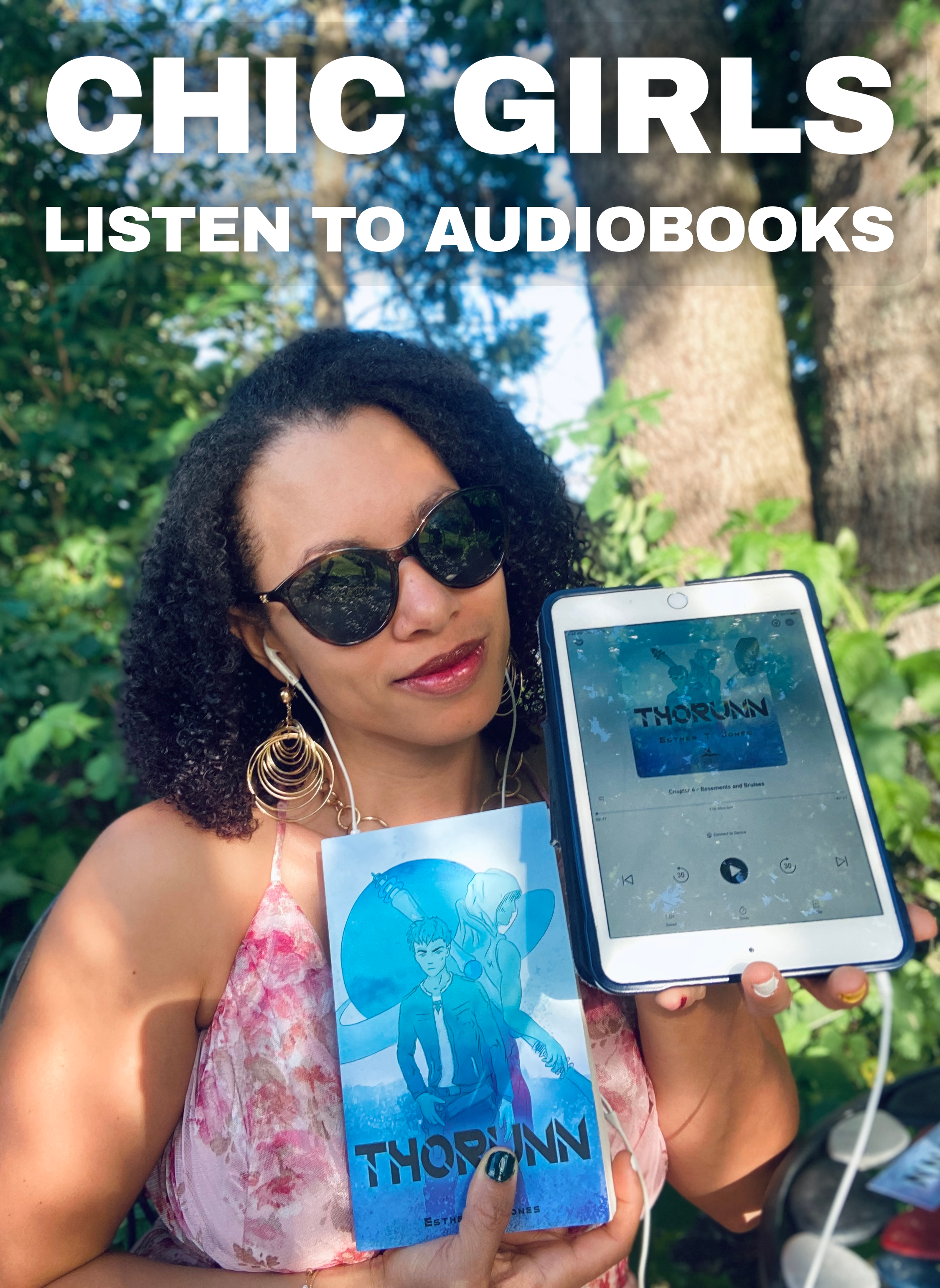
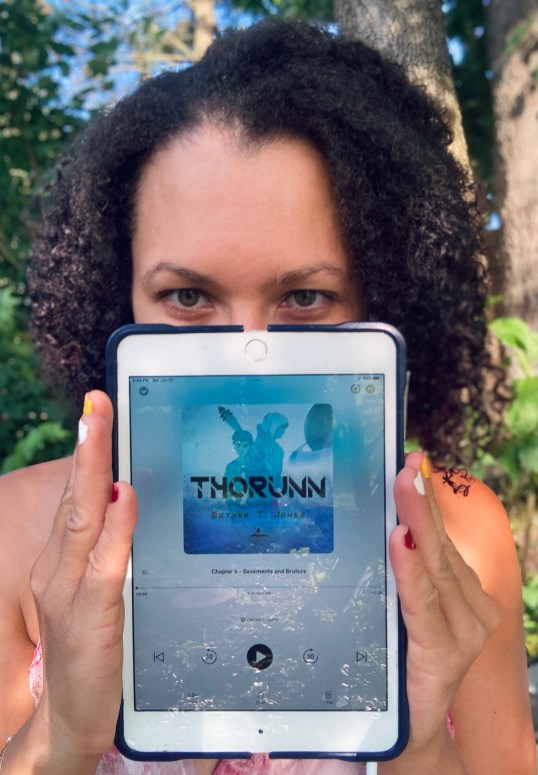
It’s finally here! ⚡THORUNN⚡ now has an audiobook companion, recorded, edited, and produced by indie author Esther T. Jones.
Over two years in the making, this dynamic and thrilling scifi adventure features over 40 voiced characters and engaging narration that brings this 13-hour story to life!
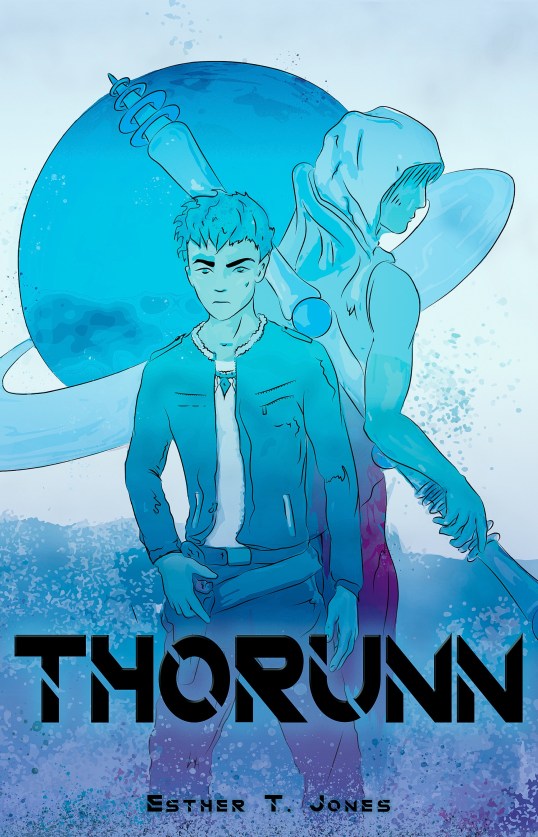
Special thanks to my cover artist Don Jones for adapting the original artwork to meet audible specifications, and a huge thank you to all past, current, and future readers of ⚡THORUNN⚡!
Your thoughtful review is much appreciated.
An exclusive, behind-the-scenes vlog featuring the making of ⚡THORUNN⚡ is coming soon!
I couldn’t be there in person, but my novels are attending the CHAP: Christian Homeschool Association of Pennsylvania 2024 convention this weekend! They’re sharing a table with the wonderful homeschool book written by my lovely mother (featured in the third pic).
Please stop by and say hi! if you’re attending the convention this weekend. 📚😃
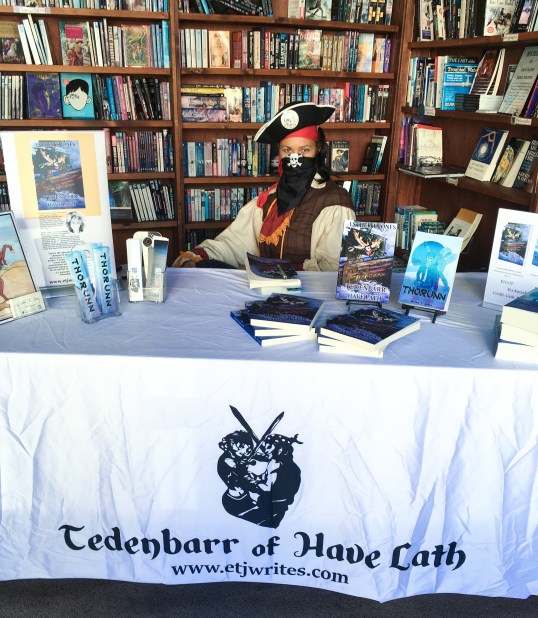
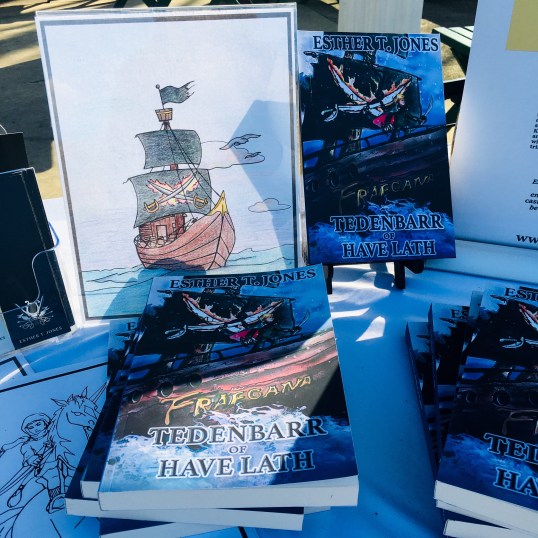
This weekend I’ll be out and about celebrating Small Business Saturday at the Countdown to Christmas Vendor event hosted at the Salem Guldens UM Church in historic Gettysburg, Pennsylvania. I’ll be there with my young adult novels Tedenbarr of Have Lath and Thorunn from 10:00 a.m. until 4:00 p.m. I’ll be signing any copies purchased on site, and I’m looking forward to seeing everyone as we get into the holiday spirit!
More details regarding the event can be found at the Salem Guldens UM Church’s Facebook page.
Here is a nifty amazon hack that’ll save you a lot on hardcover books in the future!
You can of course choose to bypass Amazon altogether and go directly to the local bookstores’ online sites, or even visit in person – I buy 99% of my books thrifted, and most of that from library booksales , but this is a neat tip I’ve used, especially to find books that have fallen out of print.
An author must choose through which lens – and how many – a story will be told. Each has its benefits and its pitfalls. Some naturally lend themselves more to a certain type of story or genre, and while a story can be solely told from one character’s perspective, there are various aspects better explored through multiple lenses. (Plus, it’s really fun!)
Using dual or multi POV is an excellent way to create and build tension, as one character might reveal something to the readers that another character has no way of knowing, something that might lead to their downfall if they’re unable to read the warning signs in time.
Multi POV also allows readers (and the author, while writing) to take breaks from being stuck inside one character’s head the entire time. Some of my favourite parts of books or television episodes are the ones where we get to look at the main characters from an outside perspective, which in turn reveals even more about the characters, the world they live in, and the overall story than we knew before.
In books, in particular, authors can create cliffhangers that pull the reader along by ending a chapter with one character in peril, and then jumping to a different character for a little bit, heightening our desire to find out what has happened.
But dual or multi POV can also go wrong and end up becoming jarring and off-putting to readers when done incorrectly. With that in mind, here are 9 tips I’ve picked up both as a reader and a writer to help you write multi POV with confidence to create an irresistible reading experience.
Limit POV Characters
My first tip – especially for newbie writers – is to limit the amount of characters telling the story.
Instead of giving everyone and their grandmother a chance to narrate the story, limit the perspectives to the protagonist, antagonist, and possibly a side character or two. Keeping track of a huge cast of named characters is difficult enough in single POV, but when you’re adding multiple voices into the mix, reducing the perspective to 2-5 main characters makes the story much easier for readers to follow and helps to reduce plot holes.
Keep POVs Centered Around the Main Characters/Plot
As a reader, multiple perspectives lose me entirely when the POVs veer into side-quest territory. I do enjoy side quests when undertaken by the main character, but if secondary character no. 3 is off having their own adventures with secondary character no. 4, and nothing of their plot lines effect, or even in any way relate to the main character or overarching story being told, I greatly struggle to maintain interest in the book. I didn’t sign up to read about these random characters, and so I feel a bit cheated and like I’ve wasted my time on a plot line that went nowhere.
To combat this, make sure other perspectives connect to the protagonists, antagonists, or narrative at large.
For example, my scifi novel, ⚡Thorunn⚡ , is told mostly from Laine, Kenton, and Bo’s perspectives. However, when I do dip into the minds of other characters (there are at least six other POVs we get to experience) it’s always to reveal something about the two main characters, Kenton and Laine. Yes, we get to learn about these minor characters in a way that we couldn’t have from outside their perspective, but their narratives in the story are specifically related to the main plot and characters.
Don’t Give Equal Weight to Everyone
Related to the previous idea, when using multiple that expands beyond the main characters, not everybody needs to tell the story for the same amount of time. Spending too much time with minor characters can lead to the problem mentioned above, where readers feel like their time is wasted by meaningless filler.
Now, some authors can get away with this. A notable example would be Kishimoto Masashi. Especially in the latter half the Naruto manga, whenever a new character is introduced, Kishimoto dives extensively into their backstory. But because these characters’ histories are so interesting, and are tied into the world-building so well, the fact that Kishimoto was essentially using these POVs as a way to stretch out the manga as long as possible can be forgiven, overlooked even, because they are so compelling.
This however, is the exception, not the norm. George R.R. Martin spent a lot of time on POVs that fundamentally went nowhere in his A Song of Ice and Fire series, and even though his books are critically acclaimed, many readers were left frustrated at the amount of unnecessary plot. Martin himself has admitted that he wrote himself into a corner with the almost excessive storylines that resulted from so many different perspectives. Unless you’re interested in spending years untangling story threads, it’s best to keep outside POVs simple, focused, and short.
Be careful, however, not to make your POVs too short. If pages which are spent following one character are randomly intercut with single paragraphs featuring another character’s perspective, or if you have constantly have short section after short section jumping between POVs, it’s liable to give the reader whiplash. (Long-running soap operas are particular offenders in this area.)
Build Up to and Away From Multiple Characters
If the story absolutely demands to be told through a large cast, it can be extremely helpful to ease your way into it. Start with just a few characters and slowly add more perspectives as the story or series progresses. That way, readers have time to get to know and become attached to these characters (being introduced to them through already established POVs first), making them far more invested in following their individual stories.
Conversely, when the plot is on the edge of getting too bloated, it’s helpful to begin narrowing the story down, bringing characters back together – or killing them off – and thereby reducing the amount of POVs needed to tell the story, as happens in The Lord of the Rings.
Give Your POV a Purpose
As I mentioned in the intro, dual or multi POVs are fantastic tools to offer insight beyond what the main character thinks and experiences. But additional POVs shouldn’t be there simply to reach a wordcount or extend a screenplay to the desired running time.
Rather, each perspective should offer a unique view of the story that helps to expand and enrich it. If you can skip certain POVs and not miss anything, it either shouldn’t be in the story, or it should be reworked to be more meaningful to the plot.
Don’t Just Switch the Characters’ Names
This is a particularly irritating type of POV unfortunately common among romance stories. A story that features dual POV but the only difference between the perspectives is that the names have been switched is extremely boring. It’s also rather lazy writing. I’m not interested in reading the exact same story twice. Even if there are more substantial changes to the actual text, if the dialogue is carbon copy the same, as a reader, I’ll quickly lose interest.
The best stories I’ve read that retread the same ground in dual POV vary enough from each other that while it’s obviously an identical set of events from the other character’s perspective, the differences have me going back over the previous bits over and over again, comparing where they line up, and digging into the internal thoughts, feelings, and experiences of the characters. Done well, this can be some of the most fascinating storytelling. My favourite example of this in television is the Rashamon trope, where multiple characters, all starting from the same point, recount their version of a shared experience, with each character’s version wildly diverging from the others’.
Avoid 1st Person
Tip no. 6 is to avoid first person when writing dual or multi POV. Some writers can make multi POV work fantastically in first person, but unless the characters have extremely distinct or strong inner voices, reading first person multi POV can often feel as if you’re experiencing the story through the same character, which completely defeats the purpose of including more than one perspective.
It’s not good if readers can’t tell the characters apart and have to constantly flip back to the chapter headings to remember who is speaking – especially if it’s a romance novel. Men and women think differently, so their POVs should read differently as well.
By writing in third person instead, the constant use of the characters’ names will easily remind the reader from whose perspective each section or chapter is being told.
Give Each POV a Unique Voice
Related to number six, if your story demands to be written in first person, while labeling the chapters or sections does help, your characters must be distinct enough that readers can tell who is speaking regardless. Perhaps one character stutters a lot or is very snarky. One character could be extremely steam-of-consciousness, while another is guarded and spare with their thoughts.
This applies when writing third-person deep or limited as well. Again, this is something I utilised in ⚡Thorunn⚡ . Laine, Kenton, and Bo are all different people, with different life experiences. The prose I employed for Kenton is not the same as the words and sentence structures I used for Laine. During revisions I was constantly having to change sentences to better express how each character would articulate their thoughts.
Experiment with Format
Last but not least, play around with how you incorporate dual or multi POV. There’s the tried and true method of devoting chapters to differing perspectives (which is nice for labeling purposes), but POV can certainly switch within chapters as well.
Try using different mediums to communicate an outside perspective. Diary entries, newspaper clippings and broadcasts, emails and letters, and historical writings are all great ways to include information that the main character might not have access to. Some novels (such as Bram Stoker’s Dracula) are written entirely in this epistolary manner – similar to the “found footage” horror films that have become popular in recent years.
Stylistically, many novels include this information in the form of an epigraph at the beginning or ending of each chapter.
There you have it, my 9 tips on nailing dual or multi POV from a reading writer. Feel free to share your favourite POV tips in the comments!
As is the case for many of you, I suspect, this year didn’t go at all like what I had planned.
My second novel, Thorunn, was released in May, and while I’ve certainly enjoyed discussing the book online, I struggled to put together offline events, for a number of reasons. However, I refused to let all the hurdles in my way make things grind completely to a halt. I was blessed to be able to throw together a few book signing events – one a more private, impromptu event at a yard sale I co-hosted over the summer, and the other two at more prominent, public locations.
The first of these was at The Reader’s Café, a charming little bookshop-slash-cafe in downtown Historic Hanover. The cafe was once a church before being turned into the book haven it is today, and has lovely internal architecture. Since it was also International Talk Like a Pirate Day, of course I had to go in cosplay, debuting another new look by mix-and-matching pieces I had already made. It was really wonderful to connect with avid readers while supporting a small business, and I hope to return in the future with more books!
The second place I was able to visit to sign books was the captivating cave at Indian Echo Caverns. I didn’t actually make it to the caves this time, since it was so windy I was afraid my books would fly away if I stepped away to take a quick peek, but being on the grounds (under a lovely Greek-styled stone pavilion), seeing all the animals, and enjoying the sights and smells of the surrounding food trucks was wonderful in its own way. And of course, chatting with book fans was the highlight.
By now, I think it’s apparent that I rather enjoy cosplay, so again, I went dressed as a character, one I debuted on Thorunn’s launch day, Lachelle Michaels, who is a soldier appearing in the second half of the novel.
All in all, despite the many limitations this year has brought, I am so thankful I was still able to make the best of it, and I consider these events to be a success! Here’s to looking forward to 2021, and until then, happy reading!



 This weekend I’ll be out and about celebrating Small Business Saturday at the Countdown to Christmas Vendor event hosted at the Salem Guldens UM Church in historic Gettysburg, Pennsylvania. I’ll be there with my young adult novels Tedenbarr of Have Lath and Thorunn from 10:00 a.m. until 4:00 p.m. I’ll be signing any copies purchased on site, and I’m looking forward to seeing everyone as we get into the holiday spirit!

 Be careful, however, not to make your POVs too short. If pages which are spent following one character are randomly intercut with single paragraphs featuring another character’s perspective, or if you have constantly have short section after short section jumping between POVs, it’s liable to give the reader whiplash. (Long-running soap operas are particular offenders in this area.)
 Perhaps one character stutters a lot or is very snarky. One character could be extremely steam-of-consciousness, while another is guarded and spare with their thoughts.